End-of-studies internship at Secure-IC (Rennes, Feb–Jul 2024). Team: HOST SW Agent Program, Chip to Cloud Department. Supervisor: Sofiane TAKARABT.
Context
Secure-IC’s Securyzr iSE is a hardware security module based on a RISC-V processor. It handles cryptographic operations, secure boot, key provisioning, and device identity for IoT/automotive/defense markets. The firmware running on it contains sensitive IP.
The goal: evaluate obfuscation tools, select one, and integrate it into the Securyzr build system to protect sensitive firmware code from reverse engineering.
Comparative Analysis
Environment
Four Ubuntu Server 22.04.4 VMs in VirtualBox 7.0 on a Windows 10 host (Dell, i5-1135G7, 16GB RAM). Each VM had 3072MB RAM and 4 vCPUs — one per obfuscator, to avoid dependency conflicts.
| Obfuscator | Type | LLVM Version |
|---|---|---|
| O-LLVM | LLVM plugin | 4.0.1 |
| Hikari | LLVM plugin | 15.0.2 |
| Pluto | LLVM plugin | 14.0.6 |
| Tigress | Source-to-source | — |
Test code: prod_mat.c (matrix multiplication) and aes.c (TinyAES implementation).
Measurement tools: clock() for execution time, du for binary size, heaptrack + /bin/time for memory, BinDiff + Ghidra (BinExport) for binary similarity.
Transformations Tested
| Transform | Description |
|---|---|
| BCF | Bogus Control Flow — inserts opaque-predicate-guarded dummy blocks |
| FLA | Control Flow Flattening — routes all blocks through a dispatcher |
| SUB | Instruction Substitution — replaces operators with equivalent sequences |
| MBA | Mixed Boolean-Arithmetic |
| IB | Indirect Branching |
| FW | Function Wrapper |
| BBS | Basic Block Split |
| GLE | Globals Encryption |
| VRTLZ | Virtualization (Tigress only) — converts function to bytecode interpreter |
| TWO | BCF + FLA combined |
Binary Size Impact
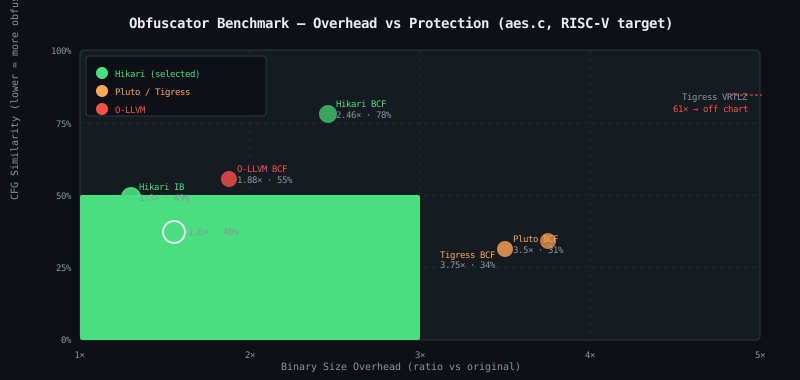
BCF and FLA introduce the most overhead. Tigress VRTLZ is extreme:
| Obfuscator | Transform | aes.c original | aes.c obfuscated | Ratio |
|---|---|---|---|---|
| Tigress | VRTLZ | 18,672 B | 2,646,922 B | 61.2× |
| Tigress | BCF | 47,960 B | 161,986 B | 3.75× |
| Pluto | TWO | 25,344 B | 89,848 B | 3.5× |
| O-LLVM | TWO | 25,376 B | 47,584 B | 1.88× |
| Hikari | SE | 25,440 B | 62,504 B | 2.46× |
SUB, FW, MBA and SE had minimal size impact across all tools.
Execution Time
O-LLVM had the worst execution time overhead. Hikari was the most efficient:
- O-LLVM FLA on
prod_mat.c: ~5× execution time ratio - O-LLVM TWO on
prod_mat.c: ~22× ratio - Tigress TWO on
aes.c: 0.9013s (excluded as outlier — 50× baseline) - Tigress BCF on
prod_mat.c: segmentation fault — binary crashed - Hikari: consistently below 4× overhead across all transformations
Similarity Scores (BinDiff)
Lower score = more divergence from original = stronger obfuscation:
| Obfuscator | Transform | Similarity |
|---|---|---|
| Pluto | BCF | 31.4% |
| Tigress | BCF | 34.3% |
| O-LLVM | BCF | 55.4% |
| Hikari | BCF | 77.9% |
| All tools | SUB | ~47–48% |
| Hikari | IB | 49.2% |
BCF is the most impactful transformation across all tools. Pluto consistently produced the lowest similarity scores (most obfuscated), but with higher execution overhead than Hikari.
Compiler Comparison: LLVM (Clang 14.0) vs GCC 11.4
- Clang takes slightly longer to compile at all optimization levels
- Both compilers improve execution time with higher
-Olevels - Clang-compiled binaries use significantly less memory than GCC at
-O1and above
Impact Analysis
A clear pattern: lower similarity score correlates with higher resource cost (size + execution time). Transformations like SUB, FW, MBA, SE produce minimal CFG changes and barely affect performance. BCF and FLA meaningfully alter the binary structure but come at a resource cost.
Hikari offers the best tradeoff: meaningful obfuscation with acceptable overhead, built on the latest LLVM version, and it didn’t produce the crashes and errors seen with Tigress.
PoC — Integration into Securyzr iSE
Obfuscator Selected: Hikari
Chosen for: widest transformation set among LLVM plugins, LLVM 15.0.2 base (most recent), best execution time performance, and no stability issues (unlike Tigress which crashed on multiple test cases).
Build Server
| Spec | Value |
|---|---|
| CPU | Intel Xeon Gold 6242R @ 3.10GHz |
| RAM | 64 GB |
| Storage | >2.5 TB |
| OS | Red Hat Enterprise Linux 8.5 |
Building Hikari
| |
Multi-architecture build targeting X86, ARM, RISC-V, and AArch64 — matching Securyzr’s RISC-V target and the x86 development environment.
Target Code
Securyzr iSE runs on RISC-V and handles pre-boot NVM (Non-Volatile Memory) generation. The NVM contains firmware that must be encrypted before being sent to the Secure Element for authentication. The encryption uses a proprietary AES GCM implementation written in C — this is the code targeted for obfuscation.
Scope was limited to the AES subset (x86-compilable, no cross-compilation required) given the 6-month internship constraint.
Build System Integration
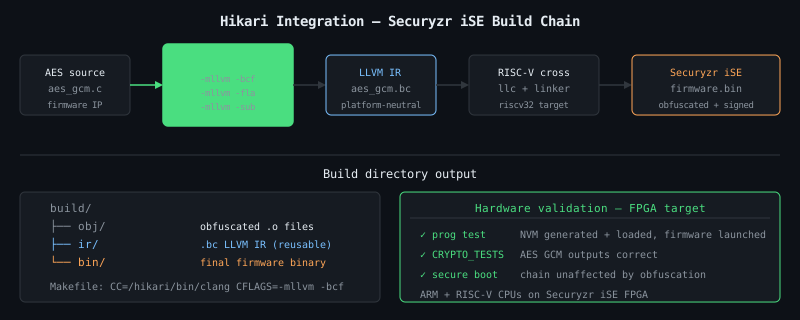
The integration required three changes to the existing Makefile hierarchy:
- Compiler replacement: switch from
gccto the Hikari-enabled clang - Compiler flags: add
-mllvm -<transformation>flags for each obfuscation technique - IR output: configure the build to emit
.ll/.bcfiles alongside.ofiles, enabling cross-architecture recompilation later
| |
The build produces a build/ directory with:
obj/: obfuscated object filesir/: LLVM IR files (platform-independent, reusable)bin/: final executable
Validation
Two tests on the target FPGA hardware (ARM + RISC-V CPUs):
progtest — launches the secure boot flow, which requires the NVM to be correctly generated and loaded. Passed: NVM was generated, transferred, and firmware launched successfully.CRYPTO_TESTS— exercises SE cryptographic functions. Passed: obfuscated AES code produced correct outputs.
The obfuscated code had no functional impact on the build process or the Securyzr boot sequence.
Challenges
- Toolchain compatibility: switching compilers in a large C project with a hierarchy of makefiles required resolving linker and library compatibility issues
- Cross-compilation: Securyzr targets RISC-V; the development server is x86. The IR-first approach (emit
.ll, recompile for target) was the path forward but hit build system complexity - Stability: Tigress generated crashes during analysis — this ruled it out for production use regardless of its obfuscation strength
- Measurement limitations:
heaptrackshowed uniform 76.8KB across all transforms (likely due to static allocation), requiring/bin/timeas a fallback for memory measurement
What I Learned
- How to benchmark obfuscation tools systematically — size, execution time, memory, CFG similarity (BinDiff)
- Why BCF and FLA have significantly more impact than SUB or MBA at the binary level
- How to integrate an LLVM-based obfuscator into an existing multi-makefile C build system
- The difference between obfuscation strength and production suitability — Tigress produced the most obfuscated binaries but crashed on real code
- Cross-compilation constraints in a RISC-V embedded security context