Work done during my internship at Techso Group (Casablanca, July–August 2023). Mission: study malware analysis methodologies and perform a hands-on analysis of the Cerber ransomware family. Two passes: automated with Cuckoo first to orient the analysis, then manual under Flare-VM.
What is Cerber
Cerber is a ransomware-as-a-service (RaaS) family, active primarily between 2016 and 2017. Its affiliate model made it massively distributed — operators could license the ransomware and keep a cut of ransom payments. The techniques it uses — dynamic API loading, hybrid encryption, C2 over non-HTTP channels — are still present in modern families. The goal here wasn’t to find new things about Cerber, but to build a repeatable analysis workflow on a well-documented sample.
Lab Setup
Flare-VM (manual dynamic analysis): Fresh Windows 10 VM, host-only adapter, no internet. Windows Defender and auto-updates disabled before install. Flare-VM script pulls tools via Chocolatey.
Cuckoo Sandbox (automated pre-analysis): Ubuntu host → KVM → Windows 7 guest with Cuckoo agent. Network routed through InetSim. Ran first to identify behavioral hotspots before manual analysis.
Key tools:
| Tool | Purpose |
|---|---|
| Detect-It-Easy (DIE) / exeinfope | Packer/compiler detection |
| PEStudio | PE header, imports, entropy, strings |
| Ghidra | Disassembly and decompilation |
| x64dbg | Dynamic debugging |
| FLOSS | Obfuscated string extraction |
| unpac.me | Automated unpacking |
Part I — Packed Sample
Sample info
Name      : cerber.exe
Type      : PE32 (GUI) Intel 80386
Size      : 619,008 bytes (622,592 on disk)
Timestamp : Wed May 24 20:48:34 2017 UTC
MD5       : 8b6bc16fd137c09a08b02bbe1bb7d670
SHA-1     : c69a0f6c6f809c01db92ca658fcf1b643391a2b7
SHA-256   : e67834d1e8b38ec5864cfa101b140aeaba8f1900a6e269e6a94c90fcbfe56678
Compiler  : Microsoft Visual C/C++ (2008)
Linker    : Microsoft Linker 9.0 [GUI32]
PE structure
Sections: .text 52.19% (executable), .data 0.74% (writable), .rdata 38.79%, .rsrc 8.11%
The .rsrc section contains an icon but no notable embedded resources. Headers have relocation info stripped.
Packing detection
DIE and exeinfope report no known packer — which is misleading. Disassembling .text reveals very little actual code. The real behavior appears only at runtime through the API call pattern: LdrGetProcedureAddress is used to dynamically resolve LoadLibraryExA, GetProcAddress, VirtualAlloc, and VirtualProtect. This is the signature of a custom unpacking stub. The packed sample was unpacked using unpac.me to get the payload.
Import table (packed version)
The packed version’s import table is large and suspicious even before unpacking:
- File operations:
CreateFile,CopyFile,DeleteFile,MoveFile,FindFirstFile,FindNextFile,GetFileSize - Registry:
RegCreateKeyEx,RegDeleteKey,RegOpenKeyEx,RegSetValueEx,RegQueryValueEx - Process:
CreateProcess,CreateProcessAsUser,ShellExecuteEx,TerminateProcess - Memory:
VirtualAlloc,VirtualFree,VirtualQuery - GUI:
FindWindow,SendMessage,ShowWindow,MessageBox - Crypto: accessed via dynamic loading (not in static import table)
Part II — Unpacked Payload
Sample info
Name      : 53779238d1cc9ceddc3cf8a0debbfc2f3888a9c3cbfb0cbae4b1ae40b4aa5924
Size      : 196,608 bytes
Timestamp : Thu May 18 09:35:03 2017
MD5       : ab0953388bf5b63bbc85cd10a7b73022
SHA-1     : 5fa927f92c01364182a93d7468ba4416802cb722
SHA-256   : 53779238d1cc9ceddc3cf8a0debbfc2f3888a9c3cbfb0cbae4b1ae40b4aa5924
Compiler  : Microsoft Visual C/C++ (2010 SP1)
Linker    : Microsoft Linker 10.0 [GUI32]
Note the different compiler from the packed version — the packer stub and the payload were built separately.
PE structure (unpacked)
Sections: .text 28.13%, .rdata 2.34%, .data 66.67% (writable), .reloc 2.34%
The .rdata section has entropy 7.271 — unusually high, indicating obfuscated or encrypted data embedded in read-only data. The .data section at 66.67% is abnormally large for writable data.
Static imports (unpacked)
The static import table contains only ntdll.dll: memmove, memset, memcpy, NtQueryVirtualMemory. Everything else is loaded at runtime.
Strings in the binary reference libraries not present in the import table: crypt32.dll, kernel32.dll, ntdll.dll, urlmon.dll, advapi32.dll — all loaded dynamically via LdrLoadDll during execution.
Dynamic Analysis
Execution sequence (Cuckoo + Flare-VM)
1. Dynamic library loading
The malware calls LdrLoadDll to load its full dependency set at runtime: advapi32, crypt32, IMM32, gdi32, mpr, netapi32, SAMCLI, NETUTILS, ole32, oleaut32, powrprof, shlwapi. None of these appear in the static import table.
2. Firewall manipulation
Before doing anything visible, Cerber spawns netsh.exe to weaken the host’s defenses:
netsh.exe advfirewall set allprofiles state on
netsh.exe advfirewall reset
netsh.exe advfirewall firewall add rule name="FktwwYI8qV" dir=out action=block program="C:/Program Files/Windows Defender/MpCmdRun.exe"
netsh.exe advfirewall firewall add rule name="OpnMEgcJzO" dir=out action=block program="C:/Program Files/Windows Defender/MSASCui.exe"
The last two rules block outbound network traffic from Windows Defender’s command-line scanner and UI process — preventing real-time protection updates and threat reporting.
3. C2 communication
Cerber sends encrypted data via UDP port 6893 to a range of IP addresses:
- 178.33.160.0 – 178.33.163.255
- 178.33.158.0 – 178.33.158.31
- 178.33.159.0 – 178.33.159.31
Implemented through sendto in ws2_32. The use of UDP (not HTTP/HTTPS) bypasses basic HTTP-layer monitoring. InternetCrackUrl is also called to parse Bitcoin blockchain API URLs for payment tracking.
4. Filesystem enumeration and encryption
The malware uses FindFirstFileExW, GetFileAttributesW, NtQueryDirectoryFile to enumerate the filesystem recursively. Default directories like Pictures remain untouched — selective targeting.
For each file:
NtReadFile        → read file content to buffer
CryptEncrypt      → encrypt content (key_handle: 0x004ca898)
NtWriteFile       → write encrypted data back to file
MoveFileWithProgressW → rename to random name + random extension
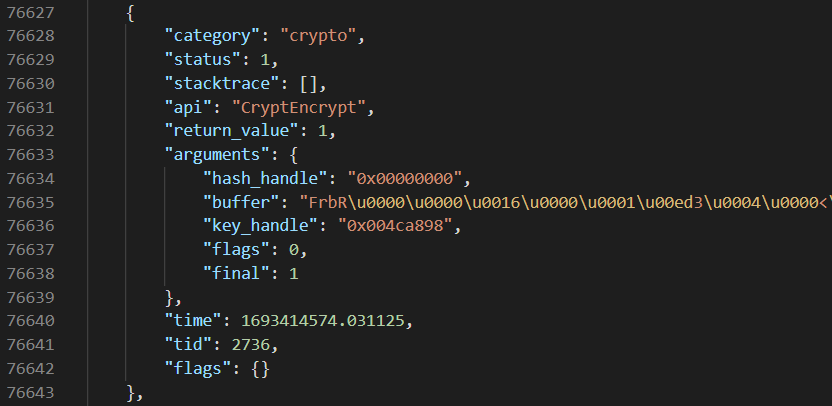
Example observed: c:\Acrobat3\Reader\ACROBAT.PDF → c:\Acrobat3\Reader\9Fck7YJuLS.af22
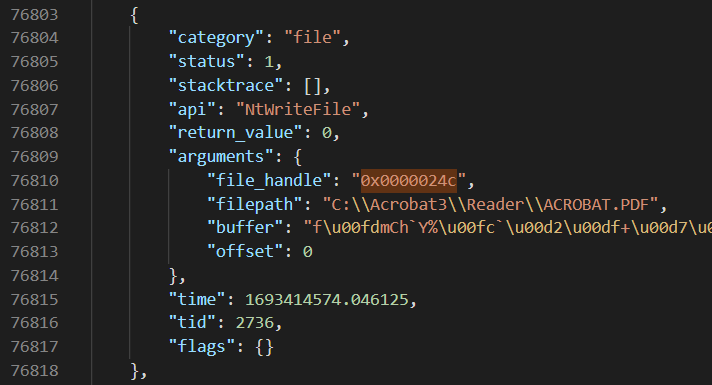
The encrypted file gets a random name with a random extension — not .cerber. This is a later variant with randomized extension behavior to evade signature-based detection.
5. Ransom note delivery
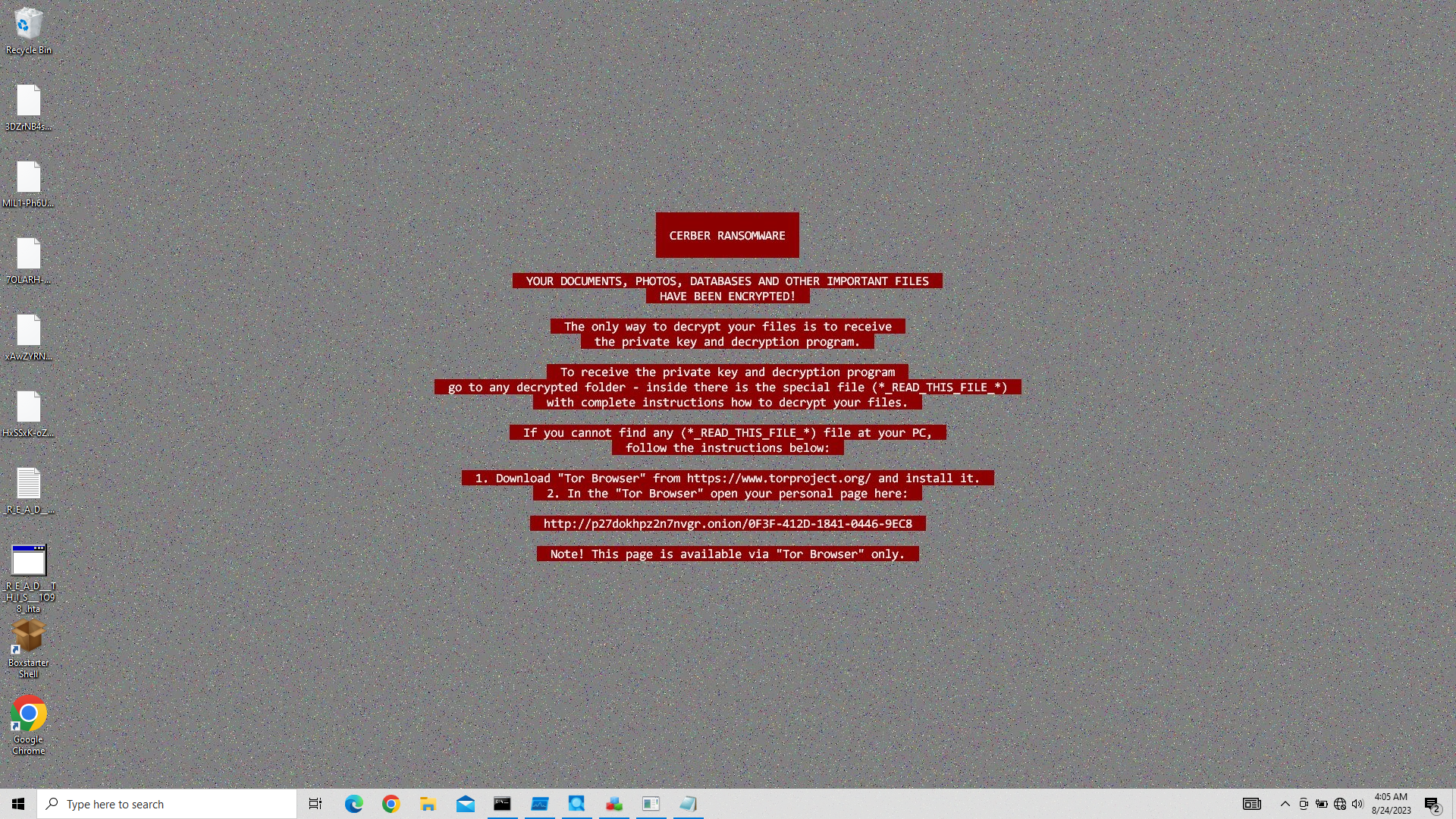
After encrypting each directory, Cerber drops two ransom artifacts:
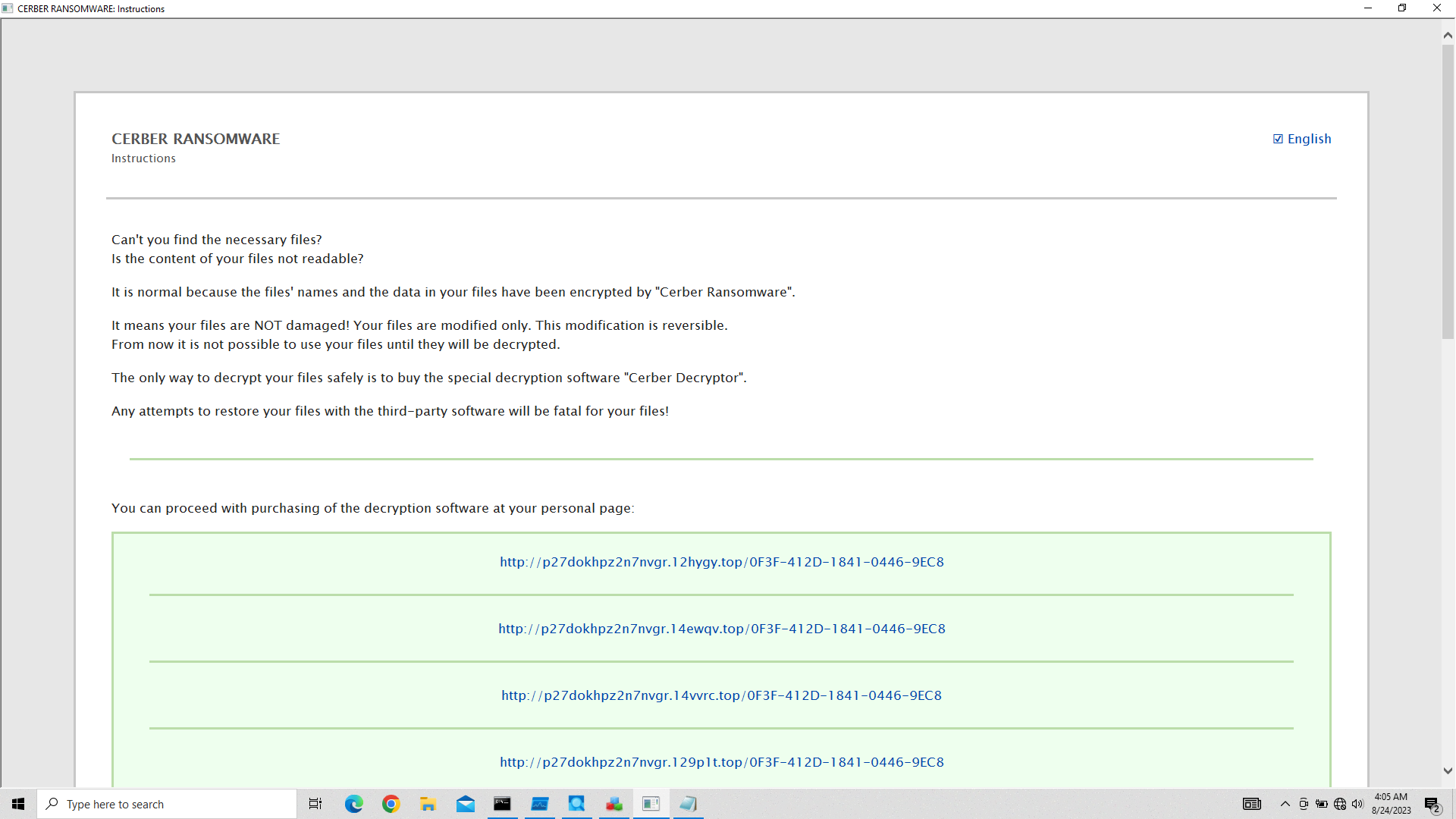
_R_E_A_D___T_H_I_S___LHYR8QK_.hta— HTML Application, launched viamshta.exe_R_E_A_D___T_H_I_S___DRIDMPY_.txt— plain text, opened vianotepad.exe
The HTA file renders a browser-like ransom page with Tor hidden service payment links.
6. Bitcoin payment tracking
Before exiting, Cerber queries Bitcoin blockchain APIs using InternetCrackUrl:
http://api.blockcypher.com/v1/btc/main/addrs/17gd1msp5FnMcEMF1MitTNSsYs7w7AQyCt?_=...
http://btc.blockr.io/api/v1/address/txs/17gd1msp5FnMcEMF1MitTNSsYs7w7AQyCt?_=...
https://chain.so/api/v2/address/btc/17gd1msp5FnMcEMF1MitTNSsYs7w7AQyCt?_=...
This polls whether the victim has paid to BTC address 17gd1msp5FnMcEMF1MitTNSsYs7w7AQyCt.
7. Self-termination
taskkill /f /im "cerber.exe"
Cerber terminates itself after completing the encryption process — a deliberate anti-analysis strategy to limit post-execution inspection time.
Evasion Techniques
- Custom packing: the packed stub is undetected by common packer scanners, uses
LdrGetProcedureAddressto reconstruct the import table at runtime - Randomized file extensions: later Cerber variants abandoned the
.cerberextension for random extensions + random filenames — breaks file-extension-based detection - Firewall rule injection: blocks Windows Defender outbound traffic before encryption starts
- Self-termination: kills its own process post-encryption
Indicators of Compromise
| Type | Value |
|---|---|
| Packed SHA-256 | e67834d1e8b38ec5864cfa101b140aeaba8f1900a6e269e6a94c90fcbfe56678 |
| Unpacked SHA-256 | 53779238d1cc9ceddc3cf8a0debbfc2f3888a9c3cbfb0cbae4b1ae40b4aa5924 |
| File extension | Random (e.g. .af22) + random filename |
| Ransom note | _R_E_A_D___T_H_I_S___[random].hta / .txt |
| C2 protocol | UDP port 6893 |
| C2 IP range | 178.33.158.0–163.255 |
| Domains | chain.so, bitaps.com, btc.blockr.io, api.blockcypher.com |
| Bitcoin address | 17gd1msp5FnMcEMF1MitTNSsYs7w7AQyCt |
| Firewall rules | Outbound block on MpCmdRun.exe, MSASCui.exe |
What I Took From This
The most useful outcome wasn’t the IoC list — it was the workflow. Cuckoo gives you an oriented starting point in 10 minutes; manual analysis under Flare-VM fills in the details.
The packing detection was a good lesson: exeinfope saying “not packed” doesn’t mean not packed. The disassembly and the runtime API call pattern are more reliable signals than static packer scanners.
The Bitcoin payment tracking via blockchain APIs was unexpected — it means the attackers can verify payment status without direct C2 contact, reducing their operational exposure.