Lab from my SICS engineering degree coursework (2024). Objective: perform both basic and advanced memory forensics on a WinXP SP2 dump — from profile identification to interactive memory inspection with volshell. All commands are Volatility 2 syntax.
Target
File    : dump_practice.dmp
Profile : WinXPSP2x86
Capture : 2016-01-03 23:00:28 UTC
Image type (Service Pack) : 2
Number of Processors : 1
KDBG : 0x8054c060L
The dump was captured 2016-01-03 but most processes started 2015-12-23 — the machine had been running for ~11 days before the capture.
1. Profile Identification — imageinfo
| |
Suggested Profile(s) : WinXPSP2x86, WinXPSP3x86 (Instantiated with WinXPSP2x86)
AS Layer1 : IA32PagedMemory (Kernel AS)
AS Layer2 : VirtualBoxCoreDumpElf64 (Unnamed AS)
AS Layer3 : FileAddressSpace (/dumps/dump_practice.dmp)
PAE type  : No PAE
DTB       : 0x39000L
KDBG      : 0x8054c060L
Image date and time : 2016-01-03 23:00:28 UTC+0000
AS Layer2 shows VirtualBoxCoreDumpElf64 — the dump was taken from a VirtualBox guest. imageinfo narrows the profile to WinXPSP2x86, which we use for all subsequent commands.
2. Process Listing — pslist
| |
pslist walks the kernel’s PsActiveProcessHead doubly-linked list — the official OS process list. Selected output:
Offset(V)  Name             PID   PPID  Thds  Hnds  Start
0x823c89c8 System             4      0    51   249   —
0x821b4020 smss.exe         492      4     4     3   2015-12-23 09:25:39
0x8229f020 csrss.exe        560    492    13   390   2015-12-23 09:25:39
0x8217b510 winlogon.exe     584    492    16   418   2015-12-23 09:25:39
0x82176b28 services.exe     628    584    16   263   2015-12-23 09:25:39
0x821b7da0 lsass.exe        640    584    20   344   2015-12-23 09:25:39
0x820fdda0 explorer.exe    1596   1568    12   379   2015-12-23 00:25:42
0x8230ada0 mspaint.exe     1772   1596     4    98   2015-12-23 01:39:56
0x820095c8 wmplayer.exe    1360   1776    29   701   2015-12-23 00:31:30
0x82077020 notepad.exe     1260   1596     0   ——    2015-12-23 01:20:49 (exited 01:40:40)
0x81f819c8 notepad.exe     1788   1596     0   ——    2015-12-23 01:42:15 (exited 2016-01-03 22:55:04)
0x81fc8020 notepad.exe     1088   1596     1    27   2016-01-03 22:56:02
Notable: 4 notepad.exe instances — 3 already exited, 1 (PID 1088) still live at capture time. wmplayer.exe PID 1360 has an unusual parent (PID 1776, which is wpabaln.exe).
3. Hidden Process Detection — psscan
| |
psscan scans raw physical memory for _EPROCESS structures by signature — not through the OS-maintained linked list. This can reveal processes hidden by rootkits that unlink themselves from PsActiveProcessHead.
Result: in this dump, psscan output matches pslist exactly. No hidden processes detected.
This is the key forensic check: if psscan shows a process not in pslist, it was actively hidden from the OS list — a strong rootkit indicator.
4. Process Handles — handles
| |
Lists all kernel handles open by mspaint.exe (PID 1772). Handles are references to OS resources — files, registry keys, events, mutexes, etc.:
Offset(V)   Pid  Handle  Type             Details
0xe10096a0 1772  0x4     KeyedEvent       CritSecOutOfMemoryEvent
0x81fffbb0 1772  0xc     File             \Device\HarddiskVolume1\Documents and Settings\pero
0x8214b810 1772  0x1c    File             \Device\HarddiskVolume1\WINDOWS\WinSxS\x86_Microsoft.Windows.Common-Controls_...
0x8215b810 1772  0x28    WindowStation    WinSta0
0x82179038 1772  0x2c    Desktop          Default
0xe1129550 1772  0x34    Key              MACHINE
0x82166f38 1772  0x38    Semaphore        shell.{A48F1A32-A340-11D1-BC6B-00A0C90312E1}
0x81fd8ca0 1772  0x40    File             \Device\KsecDD
0xe193e0f0 1772  0x50    Key              MACHINE\SOFTWARE\MICROSOFT\WINDOWS NT\CURRENTVERSION\DRIVERS32
The open file handle on \Documents and Settings\pero shows the active user profile. \Device\KsecDD is the kernel security support provider — present in most GUI processes for credential operations.
5. Registry Execution Artifacts — userassist
| |
userassist extracts Windows’ UserAssist registry keys — ROT13-encoded execution history stored in NTUSER.DAT. These keys record what programs the user launched, how many times, and when.
Registry : \Device\HarddiskVolume1\Documents and Settings\pero\NTUSER.DAT
Path     : Software\Microsoft\Windows\CurrentVersion\Explorer\UserAssist\{75048700-EF1F-11D0-9888-006097DEACF9}\Count

UEME_RUNPIDL:%csidl2%\MSN.lnk
  Count        : 14
  Last updated : 2015-12-23 00:22:13 UTC+0000

UEME_RUNPIDL:%csidl2%\Windows Media Player.lnk
  Count        : 14
  Last updated : 2015-12-23 00:31:20 UTC+0000

UEME_RUNPIDL:%csidl2%\Accessories\Notepad.lnk
  Count        : 1
  Last updated : 2016-01-03 22:56:02 UTC+0000
User pero launched MSN and Windows Media Player 14 times each in the first session (2015-12-23). Notepad was launched once on 2016-01-03 — matching the live notepad.exe PID 1088 we see in pslist.
The GUID {75048700-EF1F-11D0-9888-006097DEACF9} corresponds to the UEME_RUNPIDL class (items launched from the Start Menu Programs folder via shortcut links).
6. Kernel Modules — modules
| |
modules walks the PsLoadedModuleList to enumerate kernel-mode modules (drivers, the kernel itself). These run with full ring-0 privileges:
Offset(V)   Name           Base        Size    File
0x823fc3a0  ntoskrnl.exe   0x804d7000  0x214200  \WINDOWS\system32\ntoskrnl.exe
0x823fc338  hal.dll        0x806ec000  0x13d80   \WINDOWS\system32\hal.dll
0x823fc2d0  kdcom.dll      0xf8a50000  0x2000    \WINDOWS\system32\KDCOM.DLL
0x823fc1f8  ACPI.sys       0xf8501000  0x2e000   ACPI.sys
0x823fc188  WMILIB.SYS     0xf8a52000  0x2000    \WINDOWS\system32\DRIVERS\WMILIB.SYS
0x823fc120  pci.sys        0xf84f0000  0x11000   pci.sys
0x823eddd8  disk.sys       0xf8580000  0x9000    disk.sys
Rootkits commonly load as kernel modules or hide existing modules from this list. Cross-referencing modules against driverscan (below) catches modules hidden by manipulating PsLoadedModuleList.
7. Driver Scan — driverscan
| |
driverscan scans physical memory for _DRIVER_OBJECT structures by pool tag — independent of the module linked list. Differences between driverscan and modules output indicate hidden drivers.
Notable driver found: PROCEXP141 — Process Explorer’s kernel driver, which matches procexp.exe (PID 1204) in the process list. This confirms Process Explorer was running with its kernel driver loaded.
0x0000000021756c0 3 0 0xf8908000 0x4380 PROCEXP141 PROCEXP141 \Driver\PROCEXP141
8. Network Connections — connections
| |
Offset(V)   Local Address      Remote Address    Pid
0x81feed00  10.0.2.15:1242     50.31.192.83:554  1360
One active TCP connection: local port 1242 → remote port 554 (RTSP — Real Time Streaming Protocol). PID 1360 is wmplayer.exe. Windows Media Player was streaming media from 50.31.192.83 over RTSP — consistent with the high handle count (701) and the 14 WMP UserAssist entries.
RTSP port 554 is the standard port for streaming media servers; this is legitimate behavior from WMP, but in a suspicious binary it would be a significant C2 indicator.
9. IE History — iehistory
| |
Process: 1596 explorer.exe
Cache type "DEST" at 0x15ceef
URL: pero@http://sc1.slable.com:8126
Last accessed: 2015-12-23 01:23:20 UTC+0000

Process: 1596 explorer.exe
Location: Visited: pero@about:Home
Location: Visited: pero@res://C:\WINDOWS\system32\shdoclc.dll\dnserror.htm
User pero had IE open with a custom URL on sc1.slable.com:8126 and visited the IE default error page (dnserror.htm) — which typically appears when DNS fails or the network is unavailable. The about:Home visit is the IE start page.
10. Console History — consoles
| |
ConsoleProcess: csrss.exe Pid: 560
Console: 0x4e23b0 CommandHistorySize: 50
HistoryBufferCount: 1 HistoryBufferMax: 4
Title: ??\WINDOWS\system32\cmd.exe
A cmd.exe session was open (managed by csrss.exe). The command buffer size is 50 but only 1 history buffer active, suggesting the console was open but few commands were typed. Actual command content was not recovered in this dump.
11. Thread Inspection — threads
| |
threads enumerates _ETHREAD kernel structures for PID 1088 (notepad.exe):
ETHREAD: 0x81f99da8  Pid: 1088  Tid: 1488
Created: 2016-01-03 22:56:02 UTC+0000
Owning Process: notepad.exe
State: Waiting:WrUserRequest
BasePriority: 0x8
StartAddress: 0x7c810867 kernel32.dll
State WrUserRequest means the thread is blocked waiting for user input — exactly what you’d expect from a Notepad window open and idle. Start address in kernel32.dll is the standard thread creation point for Win32 applications.
12. Interactive Memory Inspection — volshell
| |
volshell provides an interactive Python shell with full access to the process’s address space. Current context: notepad.exe @ 0x81fc8020, pid=1088.
Disassembly at EIP:
| |
This is kernel32.dll territory — the disassembly shows a RET, NOP sled, then a full function prologue. The INT 0x2e instruction is Windows XP’s legacy system call gate (later replaced by SYSENTER).
Memory dump at ESP:
| |
Stack data at ESP shows return addresses in ntdll.dll range (0x77xxxxxx) and kernel32.dll (0x7c8xxxxx).
13. Text Extraction from Notepad — editbox
| |
editbox reads the Win32 edit control buffer directly from the process’s GUI state:
Wnd Context    : 0\WinSta0\Default
Process ID     : 1088
ImageFileName  : notepad.exe
nChars         : 17
undoBuf        : Mhm.

You are the best.
Then using the notepad plugin for all instances:
| |
The live notepad window (PID 1088) contained the text “You are the best. Mhm. g”. The undo buffer held “Mhm.” — the last edit operation was appending " Mhm." to the text. This is direct extraction from process memory without opening the file.
14. Virtual Address Descriptors — vadinfo
| |
VADs describe how virtual memory is laid out for a process — which regions are private, mapped files, or image sections:
VAD node @ 0x82167318  Start 0x00020000  End 0x00020fff  Tag VadS
  Flags: CommitCharge: 1, MemCommit: 1, PrivateMemory: 1, Protection: 4
  Protection: PAGE_READWRITE

VAD node @ 0x8200f7a8  Start 0x01000000  End 0x01013fff  Tag VadI
  Flags: CommitCharge: 3, ImageMap: 1, Protection: 7
  Protection: PAGE_EXECUTE_WRITECOPY
  FileObject @ 820759e0, Name: \Device\HarddiskVolume1\WINDOWS\system32\notepad.exe
VadS (private stack/heap regions) have PAGE_READWRITE. The VadI entry at 0x01000000 is the mapped image of notepad.exe itself — PAGE_EXECUTE_WRITECOPY is the standard protection for executable image sections in Windows.
VAD inspection is useful for detecting process injection: a PAGE_EXECUTE_READWRITE region that doesn’t correspond to a mapped image is a strong shellcode indicator.
Key Takeaways
| Finding | Plugin | Significance |
|---|---|---|
| Profile: WinXPSP2x86 | imageinfo | Foundation for all other commands |
| No hidden processes | psscan vs pslist | No rootkit active in this dump |
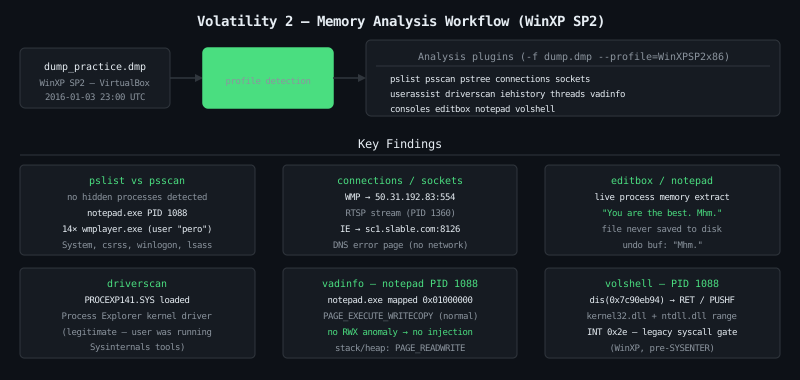
| WMP → RTSP stream to 50.31.192.83:554 | connections | PID 1360, legitimate streaming |
| User “pero”, 14× WMP, 1× Notepad | userassist | Execution timeline reconstruction |
| PROCEXP141 driver loaded | driverscan | Process Explorer was running with kernel driver |
| Notepad text: “You are the best. Mhm.” | editbox / notepad | Live process memory extraction without file access |
| notepad.exe VAD mapped at 0x01000000 | vadinfo | Normal image mapping, no injection detected |
The pslist/psscan comparison is the core hidden process detection technique. The editbox extraction demonstrates that memory forensics can recover document content even if the file was never saved to disk.