Academic lab — FSI M2, application security module. Target: Zyxel firmware binary (
455ABUJOCO.bin). Goal: extract the filesystem, identify sensitive data, and recover credentials through cryptographic attacks.
Environment
OS: Ubuntu VM
Tools: binwalk, pkcrack, hashcat, Python (wordlist generation)
Target: 455ABUJOCO.bin — Zyxel router/firewall firmware
Step 1 — Firmware Extraction
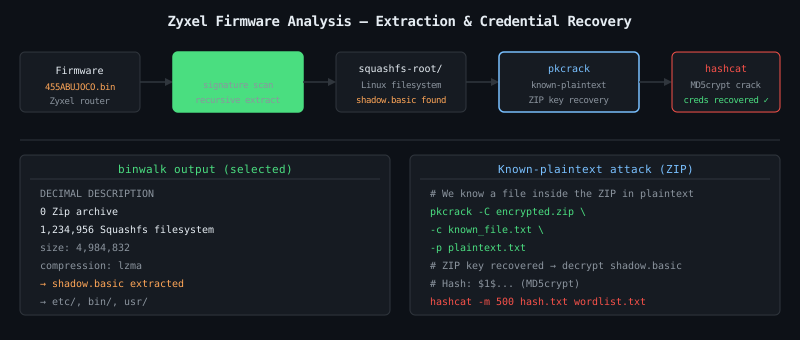
Starting with the raw firmware binary, binwalk was used to identify embedded filesystems and compression formats:
| |
binwalk identified a compressed filesystem signature inside the binary. Extraction:
| |
The extracted filesystem is a squashfs image — a read-only compressed filesystem commonly used in embedded Linux devices. Mounting it reveals a Linux directory structure:
/zyxel/
/ftp/
/etc/
/bin/
/usr/
...
Step 2 — Configuration File Discovery
Navigating the extracted filesystem, the target file was /etc/zyxel/sys/system-default.conf — a 27KB configuration file containing device settings, service configurations, and credentials.
This file appears at the same path within the firmware as it does in the ZIP archive bundled with the firmware — a key observation for the next step.
Step 3 — ZIP Cracking (Known-Plaintext Attack)
The firmware is distributed as a ZIP archive with encrypted contents. The encryption uses a legacy PKZIP stream cipher — vulnerable to a known-plaintext attack if any plaintext content is available.
Since system-default.conf was already extracted from the raw binary and exists at a known path within the ZIP, this file is the plaintext. pkcrack performs the attack:
| |
The 5 parameters:
-C— target encrypted ZIP-c— path of the known file inside the encrypted ZIP-P— ZIP containing the known plaintext-p— path of the known file inside the plaintext ZIP-d— output decrypted ZIP-a— find all valid keys
pkcrack recovered the ZIP encryption keys. The ZIP archive was fully decrypted.
Why this works: PKZIP’s traditional encryption uses three 32-bit keys initialized from the password. If an attacker has ~13 bytes of known plaintext at a known offset, the keystream can be recovered through a meet-in-the-middle attack. This encryption scheme has been broken since 1994 (Biham & Kocher).
Step 4 — Credential Recovery
Inside the decrypted archive, at /etc/zyxel/sys/, two files were found:
passwd.basic— username entriesshadow.basic— hashed passwords (MD5Crypt,$1$prefix)
The hash format is $1$ (MD5Crypt, 500 iterations of MD5). To crack:
- Generated a targeted wordlist with Python based on known Zyxel password patterns
- Ran
hashcatin mode-m 500(MD5Crypt):
| |
Result: password cracked — Pr0w!aN_fXp
The crack succeeded in seconds. MD5Crypt with 500 iterations provides minimal resistance against modern GPUs.
Vulnerabilities Summary
1. Weak ZIP Encryption (CVE class: Cryptographic Weakness)
The firmware uses PKZIP legacy encryption — a stream cipher broken in 1994. A known-plaintext attack recovers the full archive with one file that exists in both the encrypted ZIP and the raw binary.
Fix: Use AES-256 encrypted ZIP (WinZip AES or 7-Zip AES), or sign and encrypt the firmware with asymmetric cryptography.
2. Sensitive Credentials in Accessible Configuration Files
shadow.basic and passwd.basic are stored inside the firmware archive without additional protection beyond the (now broken) ZIP encryption. Once the ZIP is decrypted, credentials are directly accessible.
Fix: Do not store plaintext or weakly hashed credentials in firmware images. Use device-specific keys derived at provisioning time.
3. Weak Password Hashing
MD5Crypt ($1$) is deprecated. 500 iterations provide negligible cost to an attacker with GPU access.
Fix: Use bcrypt, scrypt, or Argon2 for password storage.
Attack Chain Summary
455ABUJOCO.bin
    │
    ├── binwalk -e → squashfs extraction
    │       └── /etc/zyxel/sys/system-default.conf (27KB)
    │
    ├── pkcrack (known-plaintext on PKZIP)
    │       └── decrypted_firmware.zip
    │               └── shadow.basic, passwd.basic
    │
    └── hashcat -m 500 → Pr0w!aN_fXp
What I Learned
- Firmware analysis starts with
binwalk— it identifies compression and filesystem signatures regardless of the file extension - PKZIP legacy encryption is fundamentally broken — one known file inside the archive is enough to recover all keys
- MD5Crypt is not a secure password hashing scheme for modern threat models — cost is too low
- Configuration files in firmware often contain more than expected — default credentials, service tokens, network configuration
- The attack chain (extract → identify overlap → known-plaintext → hash crack) is entirely reproducible with public tools